The race to bring the world’s leading AI companies to the public markets is officially underway.
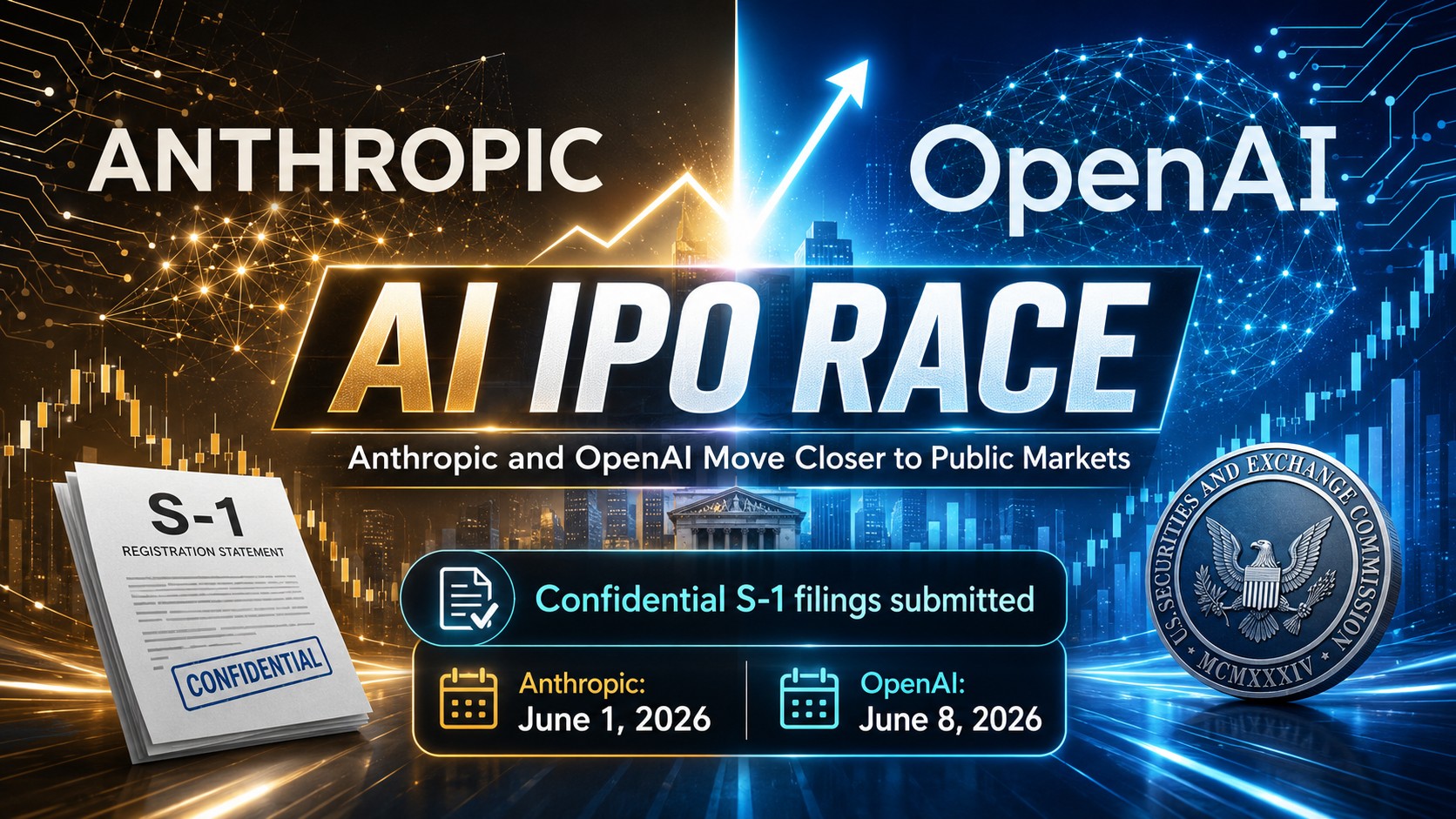
Anthropic confidentially submitted a draft Form S-1 to the U.S. Securities and Exchange Commission on June 1, 2026. OpenAI followed with its own confidential submission on June 8. Both companies have now entered the SEC review process, although neither has publicly disclosed its financial statements, offering size, share price, ticker symbol, or final listing date.
Anthropic currently appears to be slightly ahead. Just days before its filing, the Claude developer raised $65 billion at a post-money valuation of $965 billion. Its IPO will still depend on the completion of the SEC review, market conditions, and other factors.
OpenAI is reportedly considering a valuation of up to $1 trillion. However, the company has emphasized that it has not made a final decision on timing and may remain private longer to complete projects that could be more difficult after becoming a public company. Recent reports suggest that OpenAI is also considering postponing its listing until 2027.
The next major signal will be the publication of their S-1 registration statements. Those filings should reveal crucial information about revenue, losses, computing costs, major shareholders, governance structures, and business risks.
For investors, the IPOs of Anthropic and OpenAI could become one of the most important tests yet of Wall Street’s confidence in the generative AI industry.
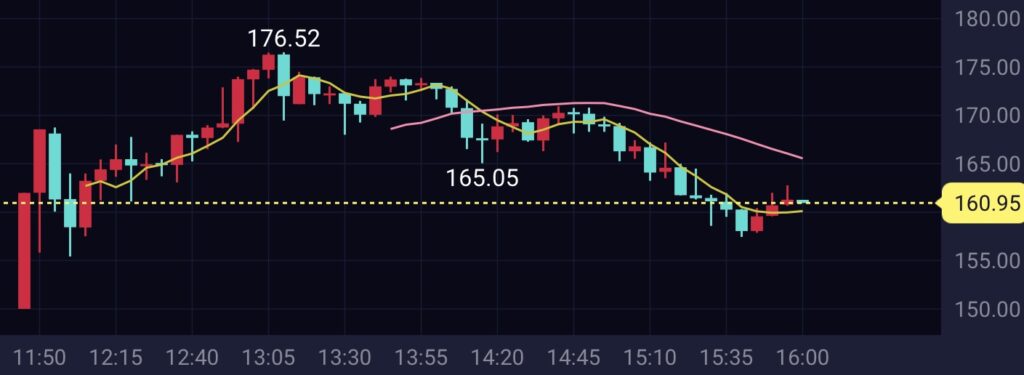
SpaceX($SPCX) closed its first day of trading at $160.95 — a huge IPO success. 🚀
The IPO was priced at $135.00. Shares opened at $150.00, surged to an intraday high of $176.52, and dipped to a low of $149.34, showing significant volatility throughout the session.
Despite the swings, the stock finished at $160.95, up 19.22% from the IPO price.
It looks like the excitement surrounding SpaceX has only just begun. This celebration may continue for a while. 🚀✨
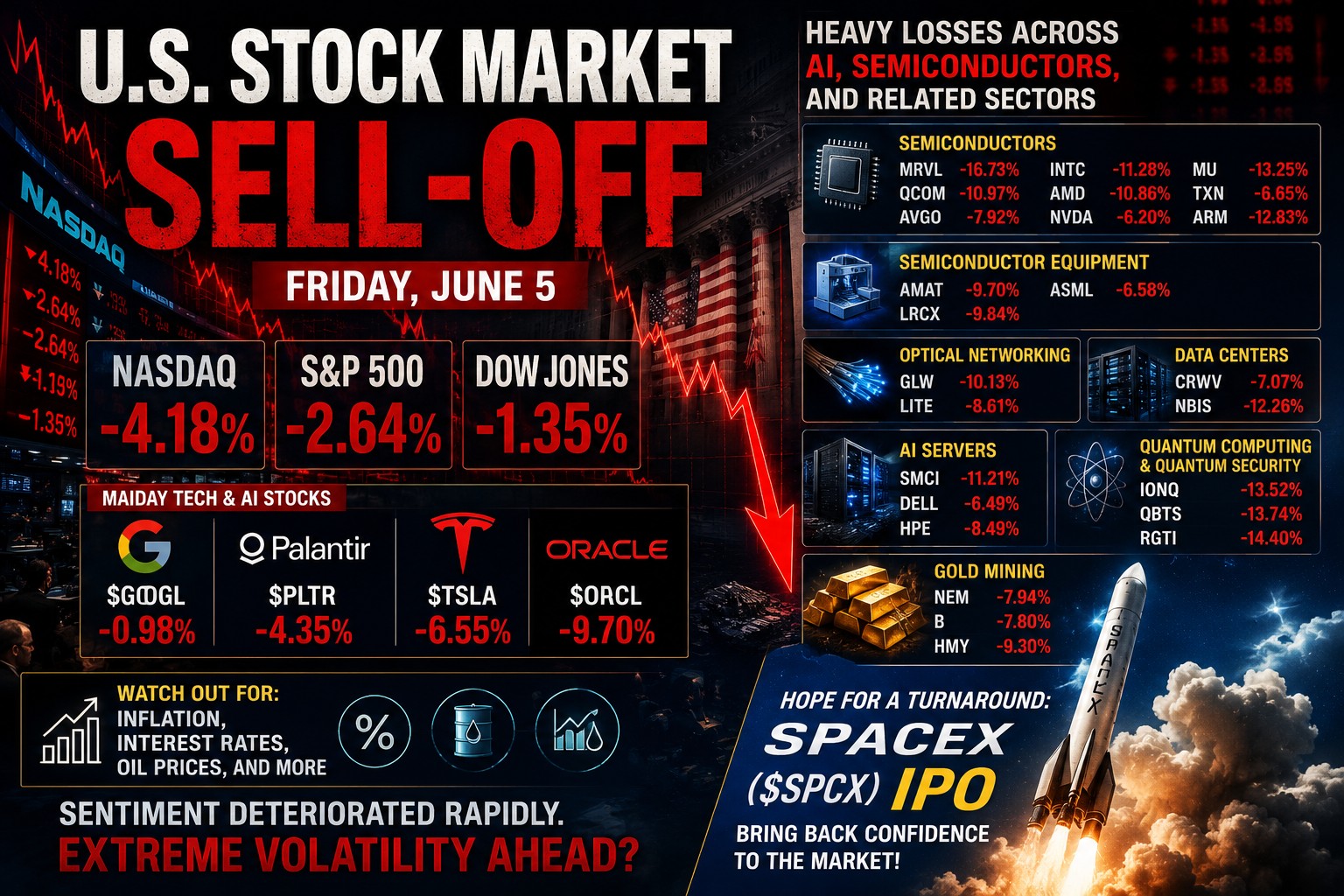
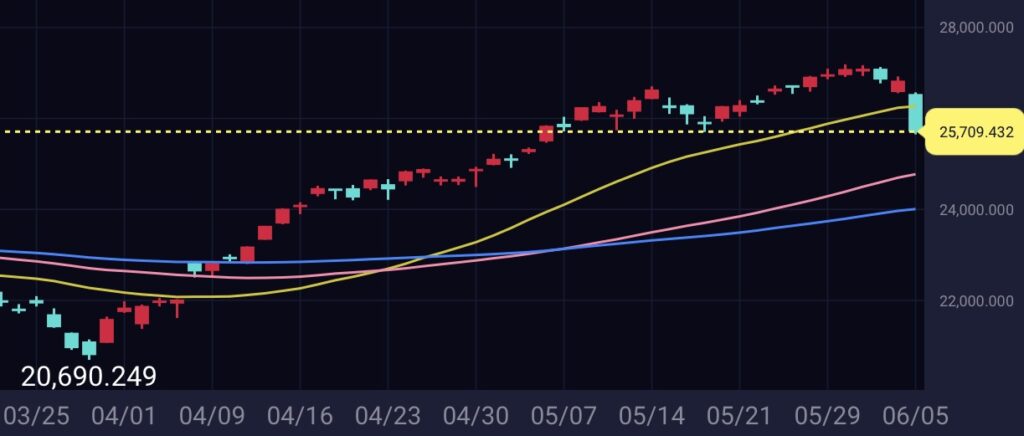
The U.S. stock market experienced a sharp decline on Friday, June 5.
Nasdaq: -4.18%
S&P 500: -2.64%
Dow Jones: -1.35%
Among major AI and technology stocks:
Alphabet ($GOOGL): -0.98%
Palantir ($PLTR): -4.35%
Tesla ($TSLA): -6.55%
Oracle ($ORCL): -9.70%
Given the severity of the broader market selloff, some of these names almost seemed to “hold up relatively well.”
The biggest declines were seen across AI, semiconductor, data center, quantum computing, and related infrastructure stocks:
Semiconductors
$MRVL: -16.73%
$QCOM: -10.97%
$AVGO: -7.92%
$INTC: -11.28%
$AMD: -10.86%
$NVDA: -6.20%
$MU: -13.25%
$TXN: -6.65%
$ARM: -12.83%
Semiconductor Equipment
$AMAT: -9.70%
$ASML: -6.58%
$LRCX: -9.84%
Optical Networking
$GLW: -10.13%
$LITE: -8.61%
Data Centers
$CRWV: -7.07%
$NBIS: -12.26%
AI Servers
$SMCI: -11.21%
$DELL: -6.49%
$HPE: -8.49%
Quantum Computing & Quantum Security
$IONQ: -13.52%
$QBTS: -13.74%
$RGTI: -14.40%
Gold Mining
$NEM: -7.94%
$B: -7.80%
$HMY: -9.30%
Investors should continue to watch inflation data, interest rate expectations, and crude oil prices closely.
Market sentiment deteriorated rapidly, but I hope the upcoming SpaceX ($SPCX) IPO can help restore confidence and bring some positive energy back to the market.
The first week of June has already delivered several important developments that could shape the next phase of the AI industry.
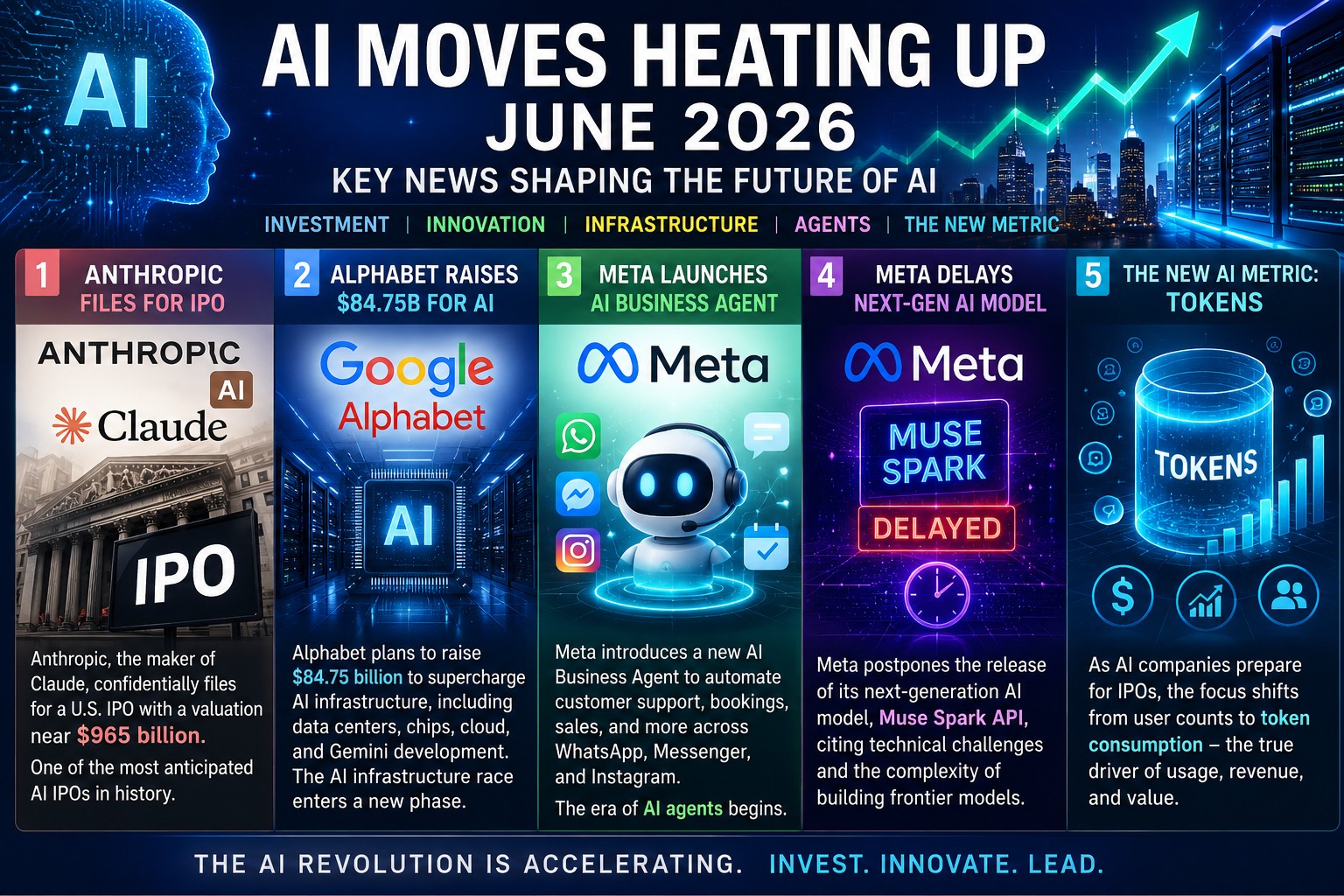
🔹 Anthropic Files for IPO Anthropic, the company behind Claude, has confidentially filed for a U.S. IPO. With a recent valuation approaching $965 billion, it has become one of the most anticipated AI listings in history and could set a new benchmark for the entire AI sector. Investors are now closely watching how OpenAI and other AI leaders respond.
🔹 Alphabet Raises Massive Capital for AI Google’s parent company, Alphabet, announced plans to raise approximately $84.75 billion to accelerate AI investments. The funding will support data centers, custom AI chips, cloud infrastructure, and future Gemini development. The AI infrastructure race is clearly entering a new phase.
🔹 Meta Enters the Enterprise AI Agent Market Meta unveiled a new AI-powered Business Agent designed to automate customer support, appointment booking, sales assistance, and other business operations across WhatsApp, Messenger, and Instagram. This signals a growing shift from chatbots toward fully autonomous AI agents.
🔹 Meta Delays Next-Generation AI Model At the same time, Meta reportedly postponed the public release of its new Muse Spark AI API. The delay highlights the increasing complexity and cost of developing frontier AI models.
🔹 The New AI Metric: Tokens As investors prepare for upcoming IPOs, industry discussions are shifting from user counts to token consumption—the actual measure of AI usage and revenue generation. Many analysts now view tokens as the key metric for evaluating AI business models.
📈 Key Themes to Watch ✅ AI IPO Boom (Anthropic, OpenAI, SpaceX) ✅ Massive AI Infrastructure Spending ✅ Enterprise AI Agents ✅ AI Economics & Token Usage ✅ Competition for AI Capital
The AI race is no longer just about building the smartest model. It’s increasingly about who can scale infrastructure, monetize usage, and attract investment capital most effectively.
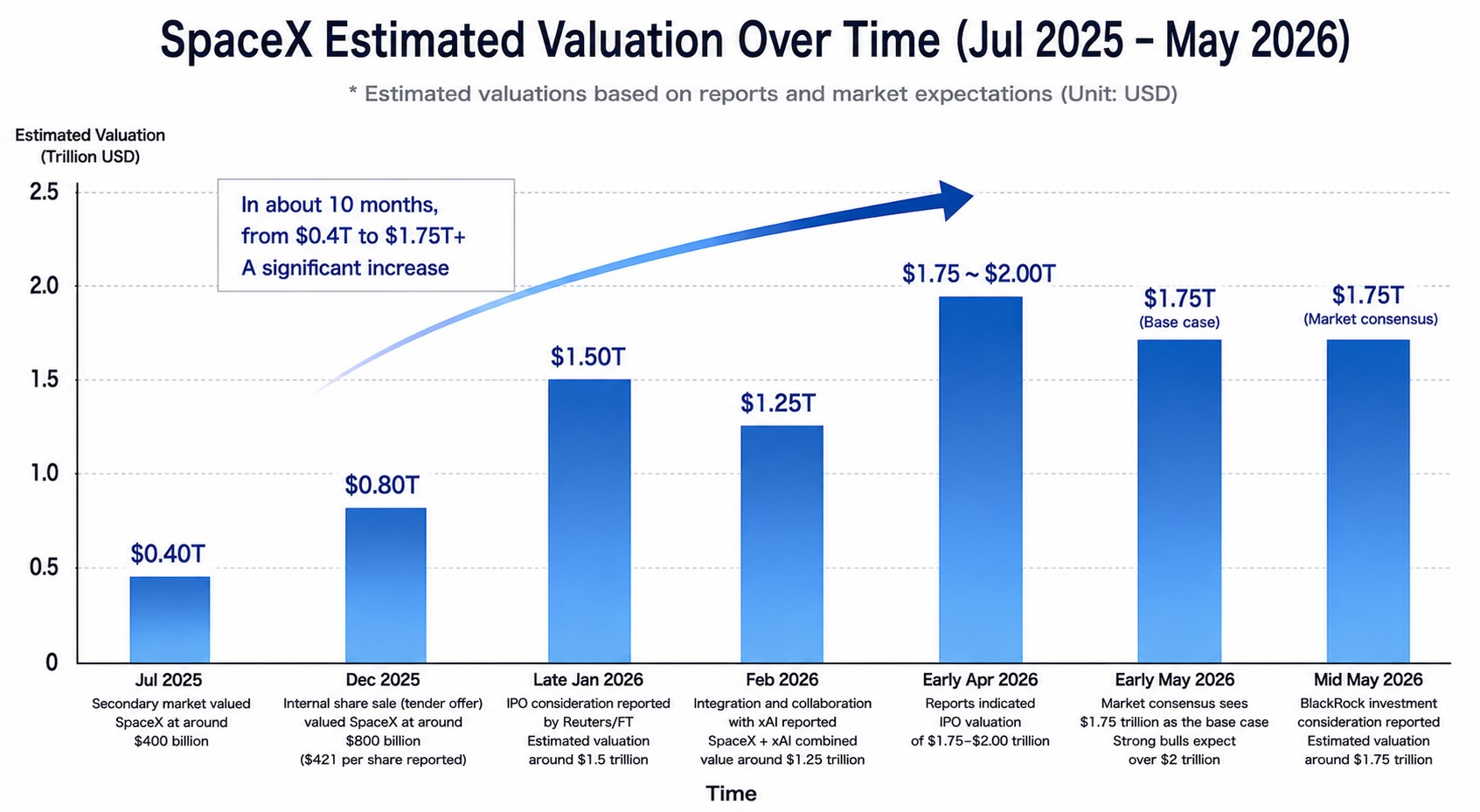
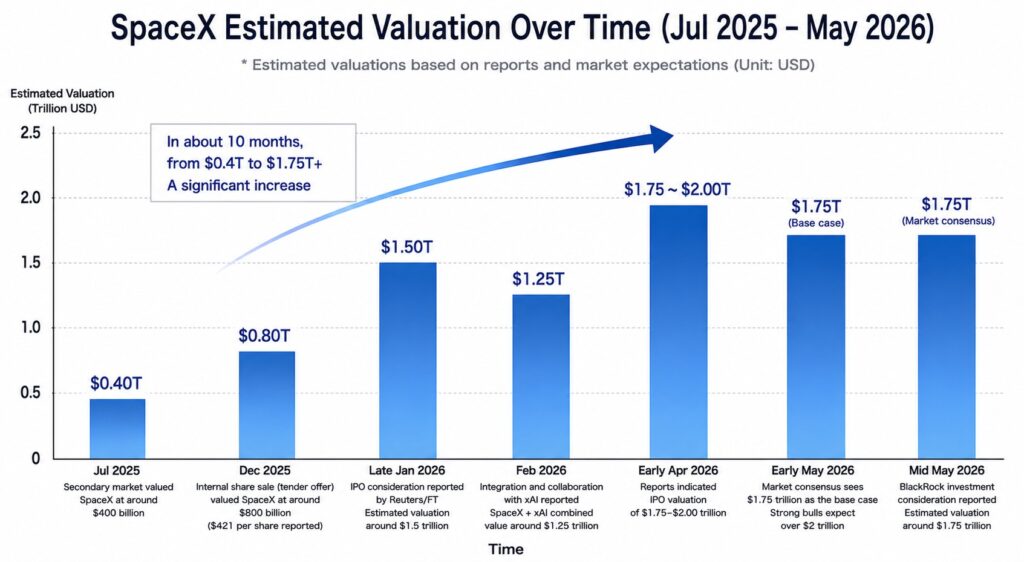
Jul 2025: Secondary markets began valuing SpaceX at around $400B. As Starlink rapidly expanded, speculation grew that a future IPO could exceed a $1T valuation.
Dec 2025: An internal tender offer reportedly valued SpaceX at around $800B, with shares priced internally at $421 each. SpaceX started being called “the world’s largest private company.”
Late Jan 2026: Reuters and FT reported that SpaceX was considering a June 2026 IPO. Estimated valuation: ~$1.5T Expected fundraising: ~$50B At this point, analysts began calling it “the largest IPO in history.”
Feb 2026: As integration and collaboration with xAI accelerated, markets increasingly viewed SpaceX + xAI as a combined AI infrastructure platform worth around $1.25T. The narrative shifted from “space company” to “AI infrastructure giant.”
Early Apr 2026: Reuters reported potential IPO fundraising of ~$75B and valuation estimates of $1.75T–$2.0T. This shocked markets, placing SpaceX near the scale of Amazon, Google, and NVIDIA.
Early May 2026: Market consensus shifted again: $1.5T became viewed as the floor, $1.75T as the base case, and bullish scenarios moved above $2T.
Drivers included:
Starlink subscriber growth
Starshield military applications
Orbital AI data center concepts
Reported AI-space initiatives with Google
May 16, 2026: Reuters reported that BlackRock was considering a $5B–$10B investment. Markets interpreted this as evidence of extremely strong institutional demand.
Current market consensus (May 2026):
Expected fundraising: $50B–$75B
Expected valuation: $1.5T–$2.0T
Most discussed valuation: ~$1.75T
There are now rumors that the IPO price could be set on Thursday, June 11, with Nasdaq trading potentially beginning Friday, June 12.
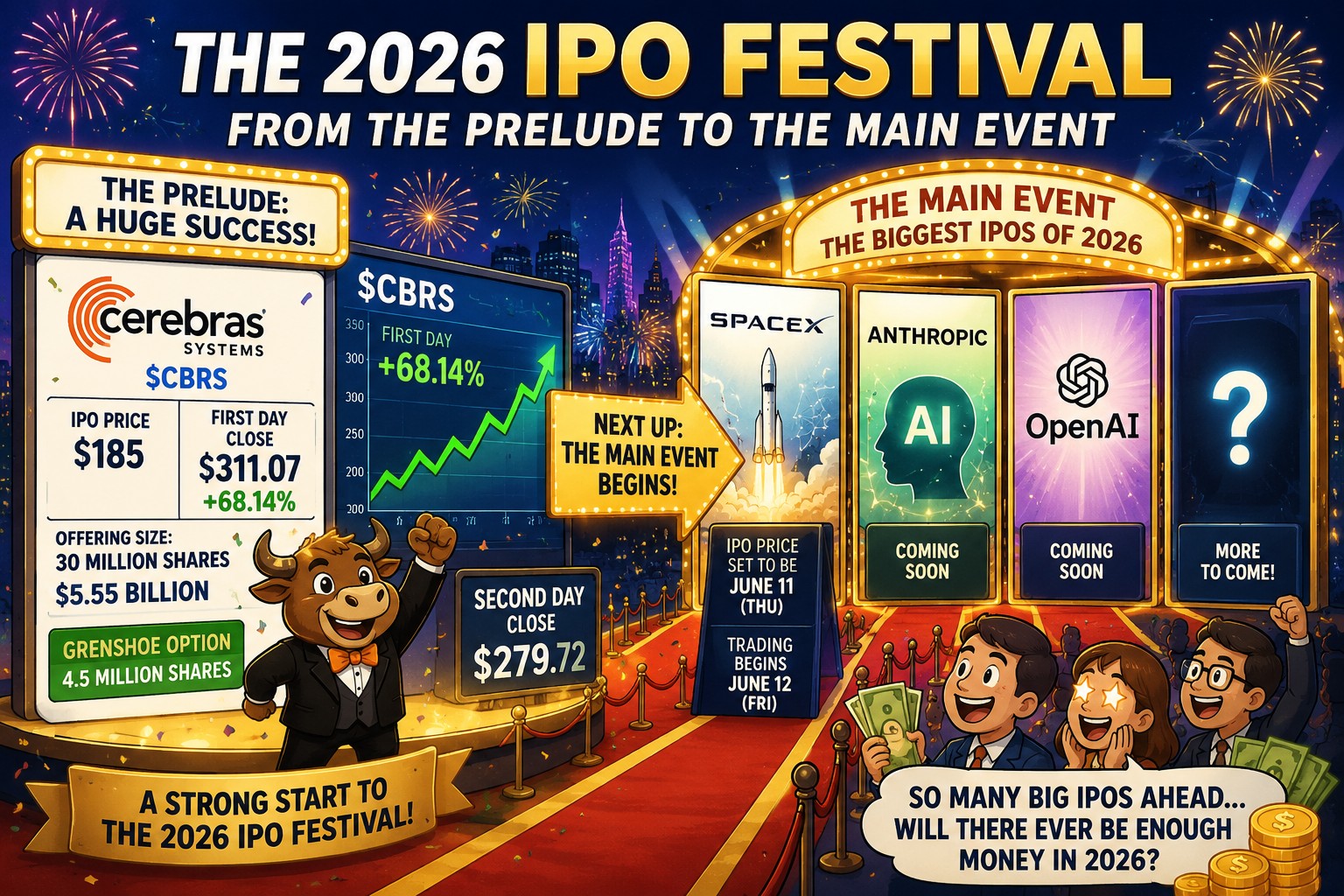
Trading of Cerebras Systems ($CBRS) officially began on the Nasdaq on Thursday, May 14, 2026. The stock closed its first trading day at $311.07. With the IPO price set at $185.00, the stock surged an impressive +68.14% on day one.
Leading up to the IPO, reports suggested that the expected offering price range had already been raised from $115–125 to $150–160, while the number of shares offered was increased from 28 million to 30 million shares. In the end, the IPO price was raised even further to $185 per share, with 30 million shares issued, resulting in a massive $5.55 billion offering. In addition, the lead underwriters were reportedly granted a 4.5 million share over-allotment (greenshoe) option.
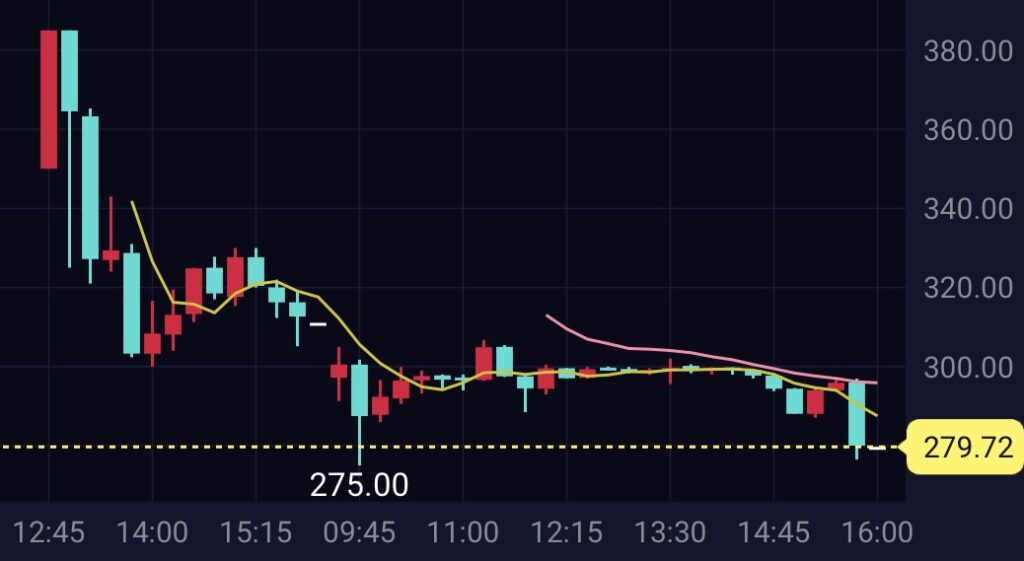
Although CBRS pulled back slightly on Friday, May 15, the stock still closed at a very strong $279.72. It seems fair to say that this “prelude” to the 2026 IPO festival was a huge success.
Cerebras Systems Stock Price Movement (15-Minute Chart) (USD)
Next comes the first true main event of the IPO festival: SpaceX. For now, reports suggest that the IPO price could be finalized on Thursday, June 11, with trading potentially beginning on Friday, June 12.
And after that, Anthropic and OpenAI are expected to follow. For many investors, 2026 may already be shaping up to be a year where there simply isn’t enough capital to keep up with the scale of these AI IPOs.
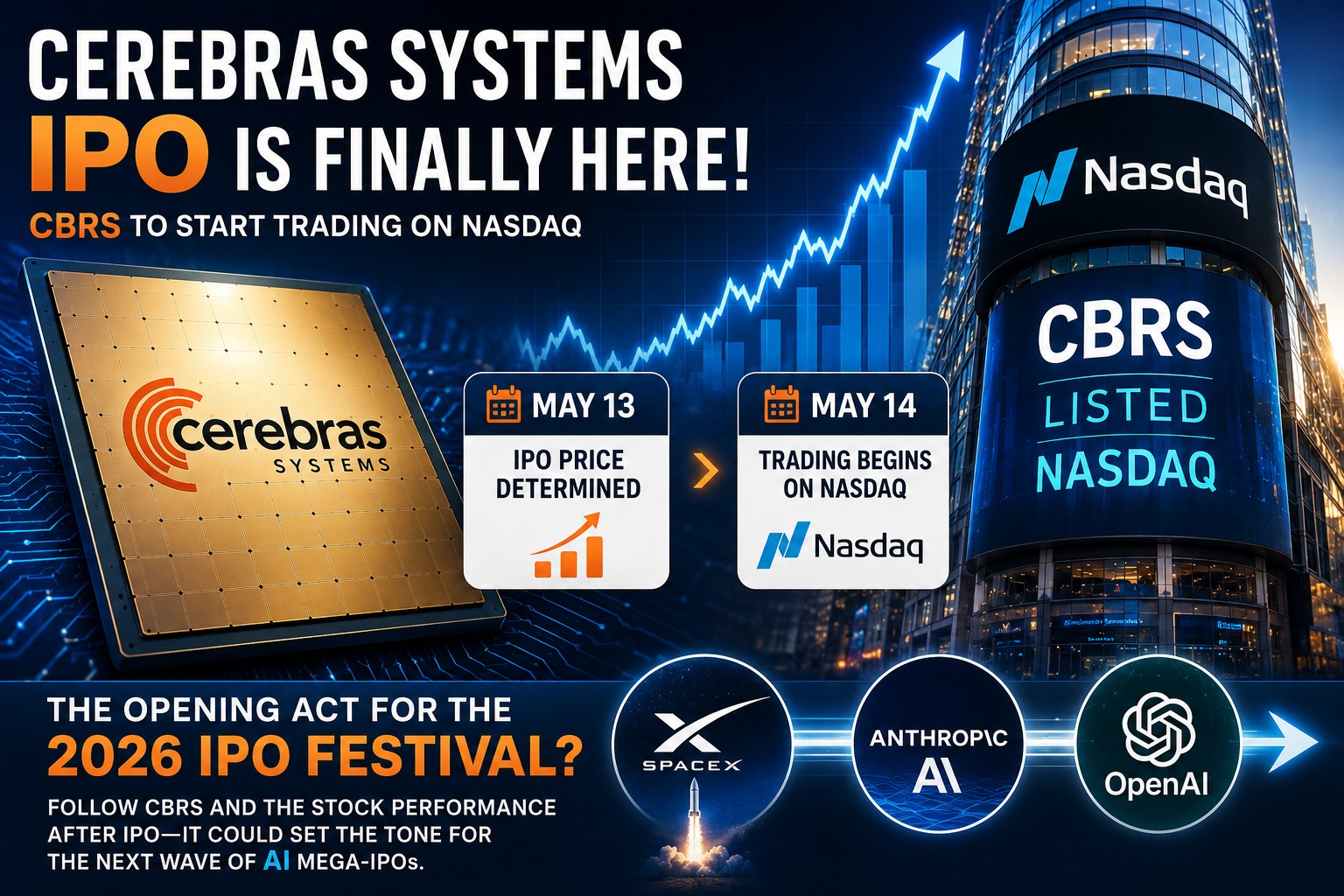
The IPO price is expected to be finalized on May 13, with trading on the Nasdaq scheduled to begin on May 14.
I won’t go too deep here into why the IPO was delayed for nearly two years or what the company had to improve to pass regulatory review — the story is complicated. But one thing is certain: many investors have been waiting for this moment for a very long time.
Either way, Cerebras could become the opening act for what may turn into the massive “IPO festival” of 2026 — potentially leading into future listings from SpaceX, Anthropic, and OpenAI.
The market reaction after the IPO — and the stock’s early trading performance — could set the tone for the next wave of AI mega-IPOs.
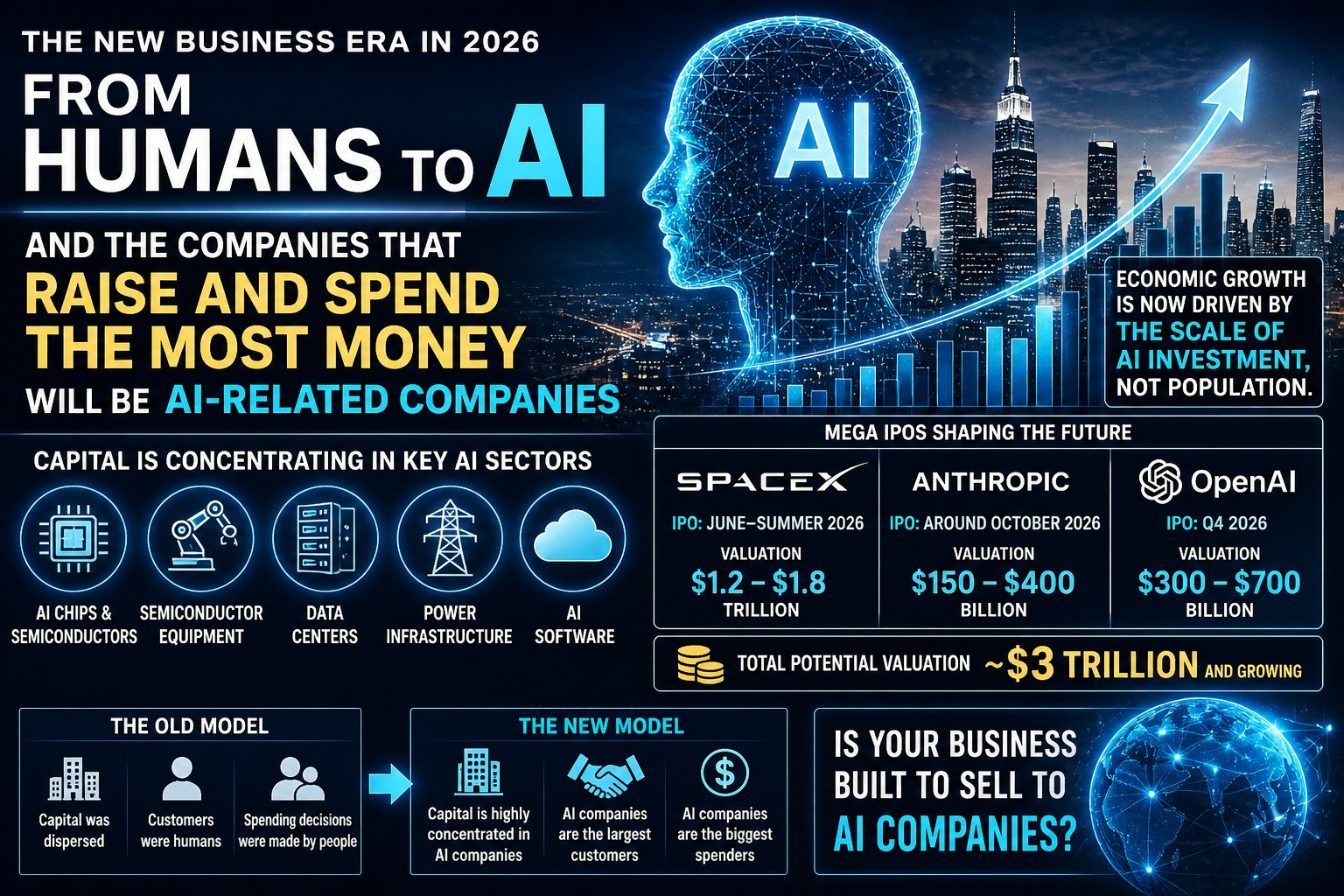
Artificial Intelligence is no longer just a technological trend. It has entered a phase where it is reshaping the very structure of the global economy.
One of the clearest signals of this shift is the ongoing wave of IPOs from major AI-related companies.
Combined, these companies alone could reach a total valuation of approximately $3 trillion. And given the upward revisions seen almost daily, this figure may only represent a starting point.
Markets are already reacting. Capital is being accumulated rapidly in anticipation of what could become a historic liquidity event.
Why Capital Is Concentrating in AI Companies
The logic behind this trend is remarkably simple:
In AI, the winner is determined by the scale of infrastructure investment.
As long as this rule holds, capital will continue to flow into AI-related companies.
The fastest-growing sectors clearly reflect this:
AI semiconductors and chips Semiconductor manufacturing equipment Data centers Power infrastructure AI software
A New Economic Structure
Who Raises and Who Spends the Money Is Changing
This is the core transformation.
From 2026 onward, the center of economic gravity is shifting:
AI-related companies will become the entities capable of both raising massive capital and deploying it at scale.
From the Old Model to the New
Before Capital raising was distributed across many industries Businesses were built around human customers Spending decisions were made by individuals or traditional enterprises After Capital becomes highly concentrated in AI companies AI companies become the largest customers AI companies become the dominant spending entities
Why AI Companies Become the Largest Spenders
There are three fundamental reasons:
Unmatched Capital Formation Power
Through IPOs, secondary offerings, and massive investment inflows:
👉 AI companies accumulate cash at a scale unmatched by other industries
Infrastructure-Heavy Nature of AI
AI is not just software—it is a capital-intensive industry:
Data centers GPU clusters Long-term power contracts
👉 Continuous, large-scale spending is structurally required
AI-related companies will both raise the most capital and spend the most capital.
Redefining “The Customer”
Within this structure, the concept of the customer itself is evolving.
Before:
Humans were the ultimate customers
Now:
Demand is increasingly generated through AI, mediated by AI-related companies
What This Means in Practice
SaaS products will be optimized for AI companies Semiconductor demand will be dominated by AI firms Power utilities will become increasingly dependent on AI demand
In short:
👉 Success will depend on whether you can sell to AI-related companies
The Collapse of “Population = Economic Growth”
The traditional assumption:
More people → More consumption → Economic growth
is breaking down.
The new reality:
AI companies’ investment scale → Economic growth
Early Signs Already Emerging
Rapid expansion of data centers by AI firms Surging global electricity demand Tightening semiconductor supply Explosive growth of AI infrastructure companies
Broader Societal Impact
This transformation will extend far beyond business:
Talent evaluation → centered on AI-related capabilities Education → focused on AI utilization and system design Corporate strategy → prioritizing alignment with AI companies National strategy → competition for AI infrastructure dominance
Conclusion
The year 2026 marks a turning point.
It is not only about who the customer is, but also about:
who raises capital, and who ultimately spends it.
The Most Important Question
Is your business designed to sell to humans— or to be selected by AI-related companies?
From Humans to AI as Customers – As the Ultimate Capital Aggregators and Spenders